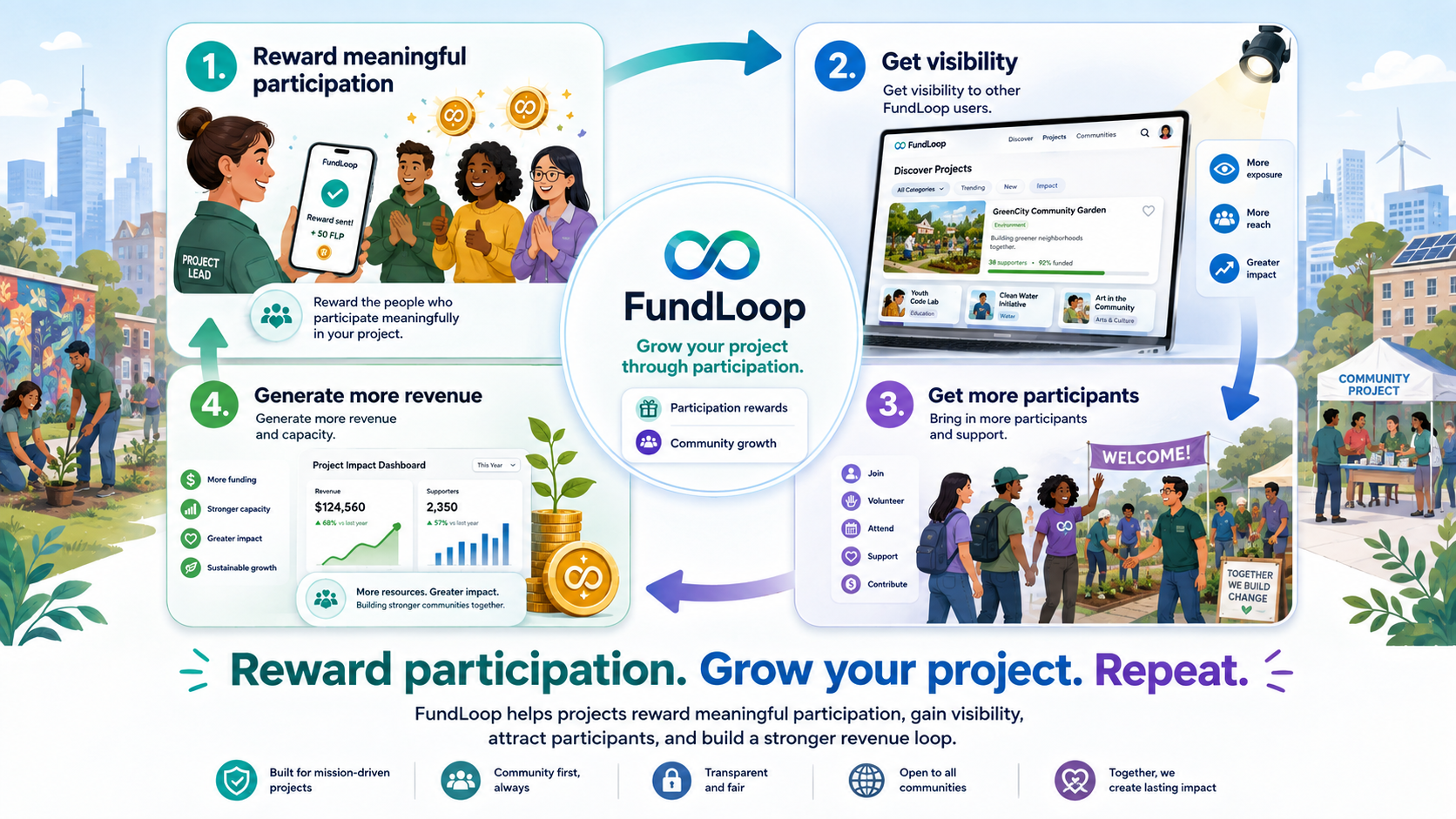
The Anti-Ad Growth Model
Compare ad acquisition with a model that redirects budget toward participation.
Use explicit assumptions to compare traditional acquisition spend with a future shared-upside workflow. The calculator models possible retention effects; it does not present them as measured results.
Why the FundLoop Loop Wins
The compound math of shared upside vs. traditional ads.
Model Retention Scenarios
Explore how different shared-upside assumptions could affect active usage instead of presenting model output as measured performance.
Compare Competitor Economics
Compare an aligned project and an otherwise identical competitor at the same ending MAU with explicit cost assumptions.
Governed Monthly Cadence
Prepare contribution, calculation, and review records while direct Base settlement remains gated.
Identity-Aware Participation
CUBID.me is the intended privacy-preserving identity anchor; production proof and payout readiness remain separate gates.
Founder handoff
A cleaner path from promise to operations.
The founder funnel now points into project onboarding, then into a real workspace for contribution routes, attribution, monthly status, and reporting.
Commitment is concrete
The 1% model, monthly cadence, and identity requirements are explained before signup.
Operations are findable
Founder project homes link to contributions, attribution, payments, and reporting without hiding the current deep routes.
Operators have a runbook
Internal teams now have cycle, deploy, identity, payout, and artifact checklists when founders need support.

Allocation and settlement visibility
The founder shared-upside control plane
Track modelled pledge splits, retention assumptions, competitor comparisons, and governed settlement status in one operational view.
Growth economics
The math: why founders join FundLoop instead of running ads
Compare redirecting a monthly ad budget into a shared-upside model with paying traditional ad platforms.
Adjust your project parameters
Assumption: the active MAU rate increases by 10 percentage points (from 20% to 30%) with FundLoop give-back incentives.
Total registered user accounts.
Monthly active users before FundLoop.
Ad spend available to redirect.
Signups from traditional ads.
Average revenue per active user.
Option A
Traditional ad spend
Total active users
240 MAU (+20% growth)
From 1,000 users, ads add only 40 active users at $25.00 per user.
Option B
The FundLoop loop
Total active users
900 MAU (+350% growth)
3,000 total users at 30% active equals 900 active participants in this model.
Redirect acquisition spend toward real participation.
Review the assumptions, then start project onboarding when the model fits.
The Founder Pledge
Prepare to route a share of monthly upside back to participating users.
Model the commitment, record the monthly evidence, and keep settlement disabled until the operating and governance requirements are satisfied.
The Alignment Commitment
"We commit to routing a recurring share of monthly revenue directly to our active community, turning our users into stakeholders and partners in our growth."
Revenue Give-Back
Record a proposed share of monthly revenue and review the obligation before any value is authorized to move.
Participation Signal
Usage context and activity are recorded cleanly without exposing raw personal user data.
Cryptographic Transparency
The target workflow requires verifiable receipts and reviewable reports; on-chain settlement is not represented as live today.
Support model
Free for participants. Supported by aligned projects. Honest about transfer costs.
FundLoop should not charge people just to be present in the network. Instead, aligned projects help sustain the loop when value actually exists to share.
Execution costs still exist. Fiat processor fees and crypto gas costs come out of money movement itself, not from a separate recurring access fee.
Users do not pay a platform subscription
Participation, discovery, and eventual eligibility should stay open rather than turning into yet another gated product tier.
Projects support the loop when there is upside to share
The contribution model is tied to real value creation, not to forcing early teams into a fixed software invoice before the system is useful.
Support should be inspectable later
The model works best when founders can point to concrete monthly obligations, submissions, confirmation, and reporting instead of vague promises.
1%+ to operations
Supports the people, infrastructure, review work, and payout-touching operations needed to keep FundLoop reliable.
1%+ to treasury
Helps promising aligned projects survive long enough to become contributors themselves, rather than relying only on projects that are already profitable.
Runtime economics and retention
Why projects stay: the shared-upside competitive moat
Compare steady-state economics for a project that models a user give-back with an otherwise identical competitor.
Active users generating monthly volume.
Linked to the growth model ARPU.
Models 5.0% competitor churn toward your project.
Identical clone
Extractive competitor
Net retained founder profit, month +1
$50,000 / mo
Needs 100 new users and $2,500/month in ads to match 1,050 MAU.
Your project
On FundLoop
Net retained founder profit, month +1
$47,250 / mo
Sustainable aligned growth without ad dependency.
01. Churn deflation
When users share in project success, the model predicts stronger loyalty and retention.
02. Organic migration
At feature parity, a credible shared-upside offer can motivate users to switch organically.
03. Reputation moat
A competitor can copy features or spend more, but cannot instantly copy an aligned community with long-term economic stake.
Monthly cadence
The founder promise only works if the monthly cycle is legible.
FundLoop is intentionally building toward a repeatable bookkeeping and distribution rhythm that founders can understand before they join and operators can verify after the fact.
01
Close the month
Lock the contribution period so the team knows which obligations, submissions, and participation records belong to that cycle.
02
Prepare and verify
Review the underlying project records, reconcile payment activity, and get the month into a state that can support fair calculation instead of guesswork.
03
Distribute with receipts
Move value through approved rails with onchain or processor-backed evidence strong enough for later audit and support work.
04
Report and improve
Use the resulting month to explain what happened, where funds moved, and what your team should tighten before the next cycle begins.
Identity and accountability
Founders should expect identity requirements anywhere trust, payouts, or growth coordination matter.
FundLoop is privacy-aware, but it is not accountability-free. Teams joining this network should expect identity-sensitive operations to tie back to real humans and verifiable project operators.
CUBID.me is the long-term identity anchor
The target architecture makes CUBID.me the source of account identity, contact details, socials, and payout-relevant KYC context rather than scattering that data across ad hoc local forms.
Proof-of-humanity is product infrastructure
Founders join not only to contribute money, but also to benefit from stronger ecosystem-wide confidence about who is human, who is accountable, and where participation signal should count.
Privacy still matters
The operating model should keep raw personal data tightly controlled while still giving projects, operators, and participants enough confidence to move value responsibly.
Inside FundLoop
Once your team is in, the founder path turns into an operating surface.
This is not meant to end on a vague partnership promise. The point of the funnel is to prepare founders for the actual tools and routines they will encounter once they start operating inside the product.
Project onboarding and profile management
Start with a personal profile, continue into a saved project draft, and publish a real project presence that can later support discovery, participation, and founder operations.
Contribution operations and collection routes
Manage monthly obligations, supported payment rails, route availability, and the wallet-aware collection setup needed to make real contributions executable.
Reporting, proof, and review loops
The product is already moving toward observability, reconciliation, and zkAS/reporting workflows so teams can explain what was contributed and what the network did with it.
What happens next
Start the founder path now, then continue into the real onboarding flow.
FundLoop already supports resumable onboarding drafts. The founder handoff is deliberately simple so a team can start now, pause, and come back without losing context.
01
Create or continue a personal profile
The current onboarding flow starts from the person who is creating the project, because founder operations still need a clear accountable human behind them.
02
Continue into a saved project draft
After your profile is in place, FundLoop can resume the project onboarding flow and save progress while your team fills in the operational details.
03
Configure payment and contribution operations later
Once the project is live, founder and project-admin surfaces take over for routes, obligations, reconciliation, and the monthly operating cycle.